

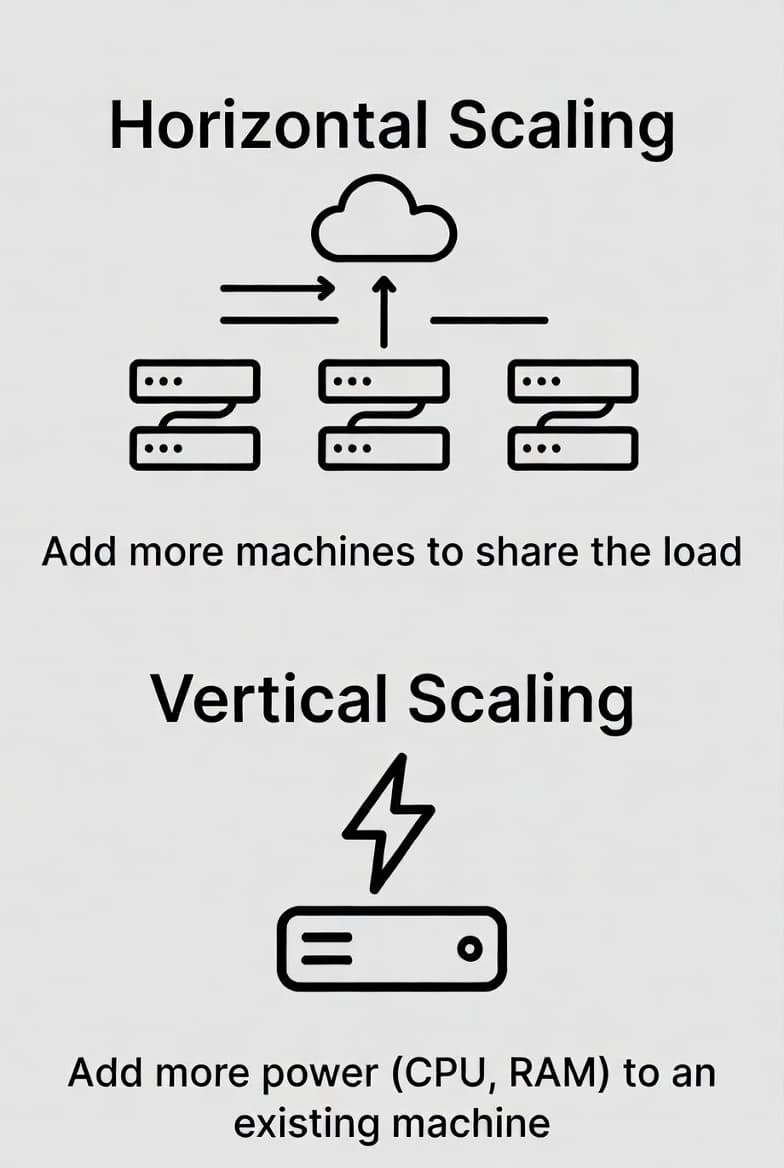
What is horizontal and vertical scaling?
📈 In System Design, it's import to understand how to scale your applications.
✅ Why do we need to understand scaling? Basically, it's helpful to make better decisions for your businesses that reduce costs, improve user experience, and optimize application performance.
🥩 What is vertical scaling?
-Vertical scaling is upgrading one computer's hardware.
These usually involves buying more expensive components of a machine like:
- -RAM(4gb vs 64gb)
- -CPU Processor(1971 vs 2026 Intel chips)
- -GPU(same as processor)
- -Storage (SSD vs HDD).
-There is a limitation with vertical scaling. You will eventually hit a hard ceiling where no more hardware can be added. It also creates a Single Point of Failure. If that one beefy machine crashes, your whole app goes down.
🥓 What is horizontal scaling?
Think instead of one beefed up computer, you add more computers(machines) or servers to distribute the workload. Since there are more, you can reduce the cost per machine and receive similar performance. It's basically about adding more machines instead of having one beefed out machine. Think bacon strips vs a hearty steak.
- -If one server fails, others keep the application running.
- -With modern day cloud solutions, cloud platforms can automatically add or remove machines based on real-time traffic spikes.
- -This creates limitless growth, as you can theoretically add an infinite number of machines.
🏢 How does it usually play out in the real world?
-Usually engineers will utilize a hybrid approach, implementing good qualities of vertical scaling and horizontal scaling.
-They combine decent computer builds "Vertical Scaling" - (RAM, GPU, Processor, Storage, etc.) to create speed and consistency.
-Then they scale out these "computer builds" to create horizontal scaling.
-This balances cost-effectiveness with high performance. In 2026, engineers use this to optimize "Pods" in Kubernetes (Dev-Ops tool for managing deployments).
🧐 These are the basics of scaling but it's important to understand and research other concepts like:
- -Load Balancers: "Traffic cops" distributing requests so no single machine gets overwhelmed.
- -Statelessness: App doesn't store data locally, so any server can handle any request.
- -Database Scaling: Harder than app scaling; involves Sharding (splitting data) and Replication (copying data).
- -Caching: Using Redis for high-speed memory access to reduce CPU and DB load.
- -Microservices: Breaking apps into small pieces to scale only the busy parts.
- -Latency vs. Throughput: Speed of one request vs. how many requests you handle at once.
‼️ For a real systems design interview, remember to research in-depth crucial details about the advantages and disadvantages(tradeoffs) of vertical vs horizontal scaling!
💡 Check out this easy explanation of caching I created: Caching Guide
Summary
Thank you for reading my blog post!
To continue learning the fundamentals of System Design, the next important fundamental to learn is understanding...
Make sure to check out the additional blogs here for materials to help you throughout your learning journeys!